
The capped mushrooms (in mycology, those which possess a 'pileus'), compose a huge portion of the fungal diversity during a hunt or foray. In Latin, the word 'pileus' was used to describe a leather hat. The pileus is used to protect the reproductive structures from the elements and other harm and used to push aside debris as the fruiting body grows.
Capped fungi are commonly separated from each other by the structures that are used to produce spores (a structure known as the 'hymenophore'). The hymenophore is always found on the underside of the cap (humoring a handful of exceptions like 'rose-combing' and effects from disturbance).
The main types of hymenophores for capped fungi are gills, pores, ridges, and teeth. Morels & Alies are included here as well simply out of their likeness of possessing a cap, even though they are more accurately known as possessing stipitate apothecia (fancy words for stemmed disc fungi) rather than 'true' caps.
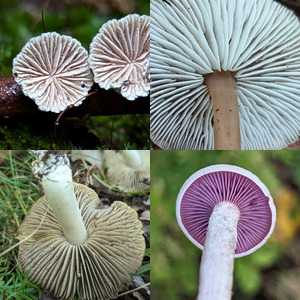
Agaric
• Gilled mushrooms. Resembling the gills of fish. With plate or blade-like structures that resemble a wheel and spoke pattern from stem to cap margin. Known as 'lamellae' in mycology.
• Spores are produced on the sides of the gills which can cause it to change color with age as more spores are produced. This different in gill color between young and mature specimens can be used as identification features.
• Many agarics feature a stem. A reduced or absent stem is typical of Oyster-like mushrooms (pleurotoids)
• The way the gills attach to the stem can be useful in identification.
👉 View all categorized Agarics
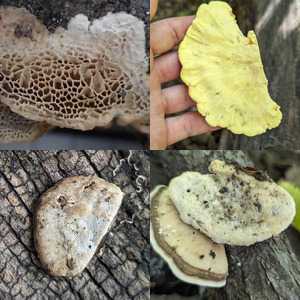
Polypore
• Underside with numerous or appearing smooth (though pores may be too small to see to the naked eye). The word 'polypore' literally means "many-pored".
• In order to separate from Boletes (other fungi with pores), check if the pores urface is easily separatable from the cap. If not, its most likely a polypore.
• Pore shapes can be round, oblong, angular, maze-like, and sometimes resembling teeth or gills.
• Most polypores have a no stem (sessile), though some have a stem or a reduced stem.
• Can be annual or perennial.
• Most grow on wood or appear to grow from the ground (growing from burried wood).
• Can be annual or perennial.
👉 View all categorized Polypores
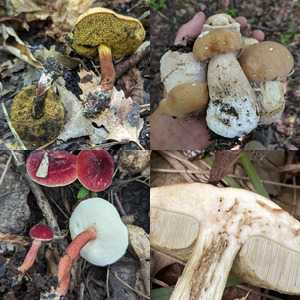
Bolete
• Underside pored and pore surface is separatable from the cap (except in Xerocomellus and the like)
• Fruiting body usually fleshy, possess a stem, and grows from the ground. Most are mycorrhizal.
• Many Boletes are colorful and undergo color changes when bruised and with age, which can be useful features for identification.
• Many Boletes are colorful and undergo color changes when bruised and with age, which can be useful features for identification.
• All boletes have stems. Stem ornimentation can be used to separate groups.
👉 View all categorized Boletes

Chanterelles & Trumpets
• Underside with raised 'ridges' resembling, though different than gills. As if a flat surface was wrinkled.
• Growing from the ground and always possessing a stem. Some are desirable edibles.
• Chanterelles are usually brightly colored (yellow and orange) and trumpets are usually black, white, yellow, or gray.
👉 View all categorized Chanterelles and Trumpets
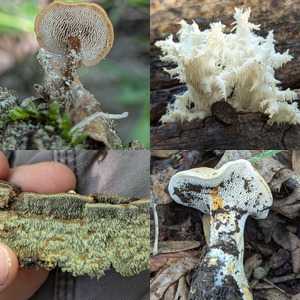
Hydnoid
• These are fungi with teeth or spines underneith.
• Some resemble polypores, some look like beards, and some are affectionally called 'hedgehogs'.
• Can be growing from soil, wood, or pine cones.
👉 View all categorized Tooth fungi
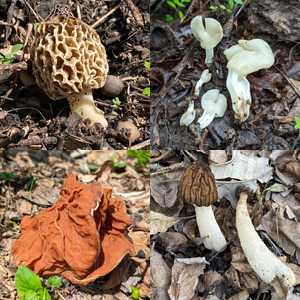
Morels & Allies (Moreloid)
• Saddled, folded, pitted, ridged, or brain-like.
• Usually with a stem; can be hollow or with brain-like contents.
• Growing from the ground (though sometimes found in well-decomposed wood) in the spring and fall.
• Morels are found in the spring.
• Members of the Disc Fungi (Discomycetes)
👉 Major group (Pezizales)
👉 Shucked corn-cob - Morels (Morchella)
👉 Brainlike or flat - Lorchels (Neogyromitra and Gyromitra)
👉 Saddle-shaped, ribbed-urn, or stemmed disc - Helvella
👉 Cone-shaped - Verpa