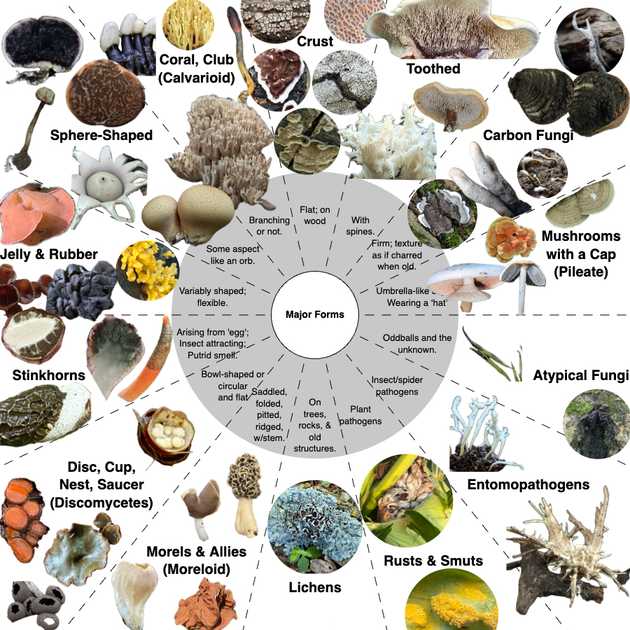
More about this key...
Classifying fungi is like trying to draw sharp lines in a watercolor wash. We humans can attempt to fit them neatly in boxes, though nature isn't structured that way. Inevitably, there are paradoxes, contradictions, exceptions, and overlap that we must account for. In Opticks (1704), Isaac Newton performed his famous prism experiment and noticed the rainbow cast by the prism divided light into seven distinct colors: red, orange, yellow, green, blue, indigo, and violet. It was later pointed out by Johann Wolfgang von Goethe in Zur Farbenlehre (Theory of Colours) (1810) that no distinct colors exist, but rather a continuous gradient of color. The human-factor is essential to making the process of observing the light spectrum intelligible, but there is something else much more innate and beautiful at work that 'muds-up' the simplistic perspective.
Biological nature is the same way. It is not clean and organized into distinct nameable objects, but rather a gradient of evolution and fallout from all genetic possibilities that 'worked' throughout time. That doesn't stop us humans from attempting to categorize the mess into clean slices. The process of categorization is completely necessary to generate a useful key for identification. For this key, an effort has been made to divide most of what would be found in nature into twelve general slices. These slices can then be divided further and further in other keys to hopefully come to a satisfying identification to species, though possibly not, as general keys aren't comprehensive. Identification to genus or family may be all the same degree of satisfaction. The mycologist must always keep in mind that which we have not found (especially in North America), which contradictions may exist in the biological gradient, and maintain a healthy skepticism of what we think we know.
This key is not a traditional dichotomous key (two-choice key), but rather a sunburst or wheel. This design is heavily inspired by the publication Fungi of Temperate Europe (T. Læssøe, J. Petersen), for which a free PDF of the identification wheels are available from MycoKey. A multitude of photos is used to reduce the verbosity of text, because we as humans are naturally visual pattern seeking creatures (and many people scroll past text, anyway). Below the wheels are descriptions of the slices with links to other keys, taxa, and feature filters in our fungal database. Please also note that this key depends on forms and morphology rather than lineages, so this key does not represent evolutionary or taxonomic relationships. For that, we suggest using the Structured Species List. Enjoy!
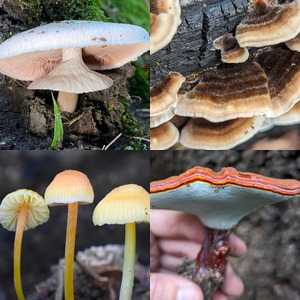
Mushrooms with a Cap 🔑
• Umbrella-like object; Wearing a ‘hat’.
• Can be on a stem (stipitate) or attached directly to the substrate from which it is growing (sessile).
• 'Pileate' in Mycologese, or bearing a 'pileus'.
• Immensly diverse. Any different lineages have developed the cap through convergent evolution.
Common groups:
👉 gilled agarics
👉 pored boletes and polypores
👉 hydnoid toothed
👉 among others. Check out the Key 🔑
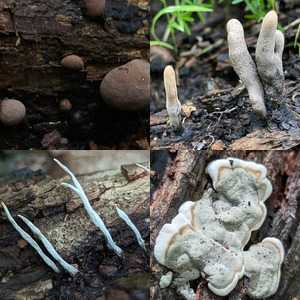
Carbon Fungi
• On close inspection, surfaces possess small bumps with openings (perithecia). Some possess a "stem"-like structure (stroma) that raise the perithecia away from the substrate (commonly on wood).
• When young, the colors can be white, black, red, gray, or orange. With age, the fruiting bodies generally turn blackish and crack like coal, describing a more formal name Pyrenomycetous Fungi or Fire Fungi.
• Shapes range from:
👉 round (Daldinia),
👉 club to antler-shaped (Xylaria),
👉 cushion-shaped,
👉 flask-shaped,
👉 sprawling-flat (Kretzschmaria),
👉 or canker-flat (Biscogniauxia).
Common groups:
👉 Order Xylariales
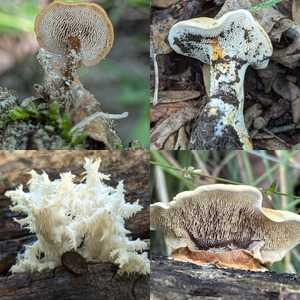
Toothed
• With spines that look like teeth.
• Many unrelated fungi fit into this group. Some resemble polypores, some agaric-like, comb-like, and some look like beards!
• The spines are covered with microscopic reproductive cells that produce spores.
👉 hedgehogs
👉 Hericium (manes and combs)
👉 polypore-like shelf and conk fungi.
👉 Use the toothed tag to view the many shapes.

Crust
• Fruiting body grows flat against its substrate (bark, barkless wood, twigs, etc.) utilizing the entire surface to reproduce spores. Formally known as the Corticioids.
• Some species grow a cap as well (known as effused-reflexed).
• Surfaces can be wrinkled, folded, smooth, worty, or toothed (if pored, it's considered a flat polypore)
👉 Use the crust tag to view the many species.
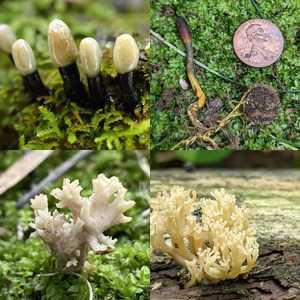
Coral-shaped or Club-shaped
• This group compose fungi that are shaped like a bat/club or branching updwardly like coral. The grouping is broad; including many linages and ecological functions (ie. decomposers, parasites, and mycorrhizal associations).
👉 Use the club or coral tags to view the many species.
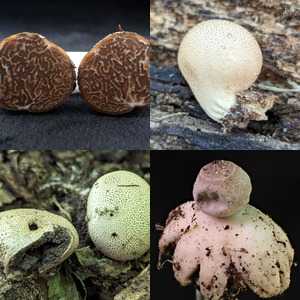
Sphere-Shaped
• This group includes fungi that possess some shereical aspect.
• These fungi mostly create spores inside rather than externally like (for example) gilled mushrooms. A trait known as gasteroid or sequestrate.
👉 puffballs (Apioperdon, Lycoperdon, Calvatia),
👉 stalked-puffballs (Tulostoma),
👉 earthballs (Scleroderma),
👉 earthstars (Geastrum),
👉 true truffles (Tuber),
👉 truffles-like fungi (Densocarpa, Hymenogaster),
👉 View all shpereical
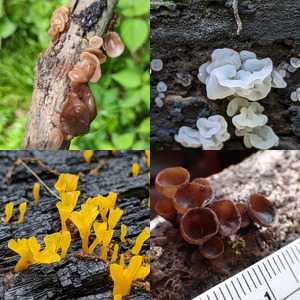
Jelly & Rubber
• Variably shaped: ear-shaped, cushion-shaped, and many looking like a deflated ballon.
• Flexible, jiggly, squishy, and gelatinous when hydrated, becoming hard and shriveled with dry weather.
• Brown, black, white, orange, or yellow.
• Many are decomposers of wood, though some encrust the bases of living plants.
• Many are decomposers of wood, though some encrust the bases of living plants.
👉 Jelly fungi (Auriculariales)
👉 Rubber fungi (Dacrymycetales)
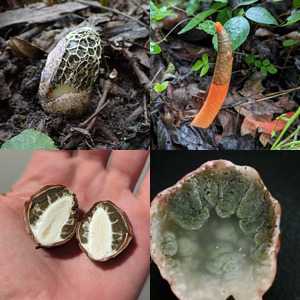
Stinkhorns
• These fungi arrise from 'egg'. When sliced in half, the egg possesses a slimy-gelatinous interior, separating it from puffballs, earthballs, and young Amanita.
• In adult form, resemble morels at first glance, though the smell and the slimy apex of the stinkhorn makes them easy to seaprate.
• The gelatinous material is composed of small spores. Flies and other insects are attrated and are eventualy covered in numerous spores which they then dispurse in other locations.
👉 Major group (Phallales)
👉 Genus Phallogaster
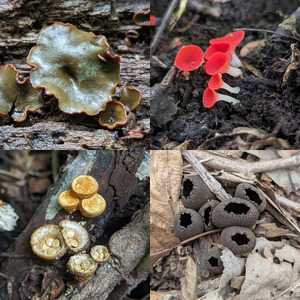
Disc Fungi (Discomycetes)
• Variably shaped; bowl-shaped, circular and flat, urn-shaped, or resembling a bird's nest.
• Appearing on the ground, attached to duff, or on decomposing trees.
• Most possess a fruiting structured called an apothecium with an upper reproductive surface (hymenium) and a lower supporting surface (abhymenium).
• Can be directly attached (sessile apothecium) or with a minimal stem (pseudostipitate apothecium), or distinct stem (stipitate apothecium).
• Morels and the like are also included in this group, however, due to their own diversity, they are handled separately in this key under the group "Moreloid".
👉 Major group (Pezizales)
👉 Bird's Nest - Family Nidulariaceae
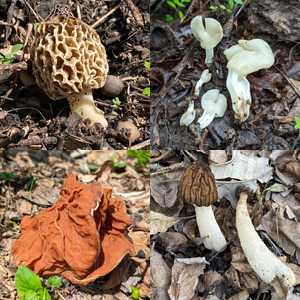
Morels & Allies (Moreloid)
• Saddled, folded, pitted, ridged, or brain-like.
• Usually with a stem; can be hollow or with brain-like contents.
• Growing from the ground (though sometimes found in well-decomposed wood) in the spring and fall.
• Morels are found in the spring.
• Members of the Disc Fungi (Discomycetes)
👉 Major group (Pezizales)
👉 Shucked corn-cob - Morels (Morchella)
👉 Brainlike or flat - Lorchels (Neogyromitra and Gyromitra)
👉 Saddle-shaped, ribbed-urn, or stemmed disc - Helvella
👉 Cone-shaped - Verpa
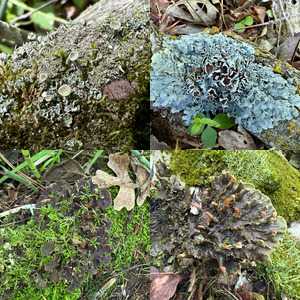
Lichens
• Grows on bark, rocks, tombstones, metal, or other stationary hard objects.
• Perrenial (found year-round), slow-growing, and can become very old.
• Colors becoming more vivid after rain.
• Combination of a fungus and a photobiont (algea or cyanobacteria)
• The fungus "farms" the photobiont for energy, while providing a safe environment for the community of algea.
👉 Major group Lichens (Class Lecanormycetes)
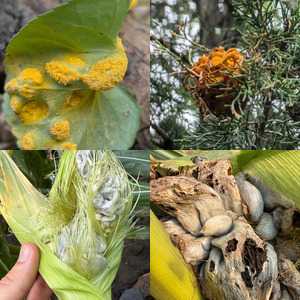
Rusts & Smuts
• Pathogens infecting leaves and fruits of many plant species.
• Juniper-Apple Rust (Gymnosporangium juniperi-virginianae) is the most commonly observed rust which creates a large ball on the cones of Eastern Redcedar (Juniperus virginiana) that grow large orange tentacles when wet. It also creates small dots on apple tree (genus Malus) leaves and has a lifecycle alternating between the two trees.
• Corn Smut (Mycosarcoma maydis) is the most commonly observed smut that infects corn cobs on the stalk and makes large gray and black growths. These growths are highly prised edibles in some cultures when gathered at the correct growth stage.
👉 Rusts (Order Pucciniales)
👉 Smuts (Class Ustilaginomycetes Ustilaginomycetes)
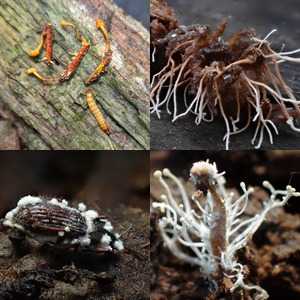
Entomopathogens
• Pathogens of insects and spiders. Entomo- is a root meaning "insect".
These fungi are way more common than we would expect, however, they are quite small and hard to find.
• Most common in Nebraska found are on insects in the Order Lepitoptera (butterflys and moths) and manytimes on the pupae (cacoon-stage).
• Some rare species infect other entomopathogens and are known as "hyperparasites".
👉 Major group - Order Hypocreales

Atypical Fungi
• Oddballs and the unknown.
👉 Mold-like on other fungi - Hypomyces
👉 Infecting Russula turning it orange/yellow - Lobster Mushroom
👉 Creating large black growths on grass/grain seeds in development - Ergot (Genus Claviceps)
👉 Creating wood-like sclerotia on Birch (Betula sp.) - Chaga (Inonotus obliquus)
This is by no means a comprehensive list. We inhabit a world of many more undiscovered, unrecognized, or uncommon fungi!